How AI is Transforming Business Intelligence in 2026
78% of organizations now use AI in at least one business function, and Gartner predicts 40% of analytics queries will be natural language by 2026. This guide separates genuine AI impact from vendor hype — covering what's working, what's overpromised, and a practical implementation framework.


- 78% of organizations utilize AI in at least one business function — up from 55% the previous year.
- Gartner predicts 40% of analytics queries will be natural language by 2026.
- Organizations effectively leveraging AI report an average return of 3.7x their investment, with top performers achieving 10.3x ROI.
- Enterprise teams report saving 40–60 minutes per employee per day with AI-integrated analytics workflows.
- The BI market is projected to reach $54.9 billion by 2029, with AI-powered analytics as the fastest-growing segment.
- 84% of businesses investing in AI and GenAI report positive returns (Deloitte, 2025).
The AI–BI Convergence: From Feature to Foundation
2026 marks the inflection point where AI transitions from a supplementary feature within BI tools to the foundational layer of the analytics experience. The tools your team uses daily — Power BI, Tableau, Looker, Qlik; are fundamentally different products than they were 24 months ago, with AI embedded at every level: data preparation, visualization, insight generation, and decision support.
This shift is backed by significant investment. Companies invested approximately $37 billion in generative AI alone in 2025, a 3.2x increase from the prior year. By 2026, over 80% of enterprises are expected to have deployed generative AI-enabled applications. Worker access to sanctioned AI tools grew by 50% in 2025.
But not all AI capabilities deliver equal value. After implementing AI-powered analytics for dozens of enterprise clients, here's our honest assessment; separating genuine impact from vendor marketing.
Five AI-in-BI Workflows Working in Production Today
1. Natural Language Analytics
Natural language processing (NLP) has progressed from a novelty to a daily-use capability. Users can now ask questions like "What were our top 5 products by revenue in Q4, and how did they compare to Q3?" and receive instant, correctly formatted visualizations.
Gartner projects that by 2026, 40% of analytics queries will be created using natural language, replacing manual chart building for routine questions. Both Power BI Copilot and Tableau Agent (Salesforce Agentforce) support conversational data interaction.
Observed in production: Clients enabling NLP queries see a 3x increase in dashboard adoption, particularly among non-technical users (marketing managers, operations leads, executives) who previously submitted ad-hoc requests to analysts. This frees analyst teams to focus on strategic analysis rather than report generation.
2. Automated Anomaly Detection
AI continuously monitors KPIs and alerts teams when metrics deviate from expected patterns; catching issues that periodic human review would miss. This shifts organizations from reactive reporting to proactive exception management.
Observed in production: A retail client deployed anomaly detection across 200+ KPIs and caught a pricing error within 2 hours instead of the typical 2 days, saving an estimated $150K in margin erosion. The system flagged a 3-standard-deviation drop in average selling price for a product category, triggering an immediate investigation that revealed an incorrect bulk discount configuration.
3. AI-Generated Narratives & Executive Summaries
AI generates plain-English summaries of dashboard data, automatically highlighting trends, outliers, and period-over-period changes. This capability is transforming executive reporting; reducing report preparation time while improving narrative quality and consistency.
Observed in production: A financial services client reduced weekly executive report preparation from 8 hours to 3 hours, a 60% time savings; by using Power BI's smart narratives to generate first-draft summaries that analysts then reviewed and contextualized. The result was faster report delivery with richer, more consistent narratives.
4. Democratized Predictive Analytics
AutoML capabilities within BI platforms (Power BI's AutoML, Salesforce CRM Analytics predictive modeling) enable business users to build predictive models without writing code, forecasting sales, predicting customer churn, estimating project completion dates, or classifying support tickets by priority.
Observed in production: A logistics company improved delivery time predictions by 40% using Power BI's built-in forecasting capabilities, without hiring a dedicated data scientist. The model was built by their operations analyst in two days and deployed directly within existing operational dashboards.
5. AI Agents: The Emerging Interface
AI agents; autonomous systems that can answer questions, perform analyses, and take actions on behalf of users, are emerging as the next evolution beyond natural language queries. By 2030, Gartner projects 45% of organizations will orchestrate AI agents at scale across business functions.
In BI, agents represent a shift from "users querying dashboards" to "agents monitoring data and proactively surfacing insights." The agent answers your question, but also tells you what question you should be asking.
Where AI-in-BI Still Breaks Down
1. "Fully Autonomous" Analytics
No AI system can replace human judgment in interpreting data within business context. AI excels at pattern detection, correlation identification, and forecasting; but understanding why a metric changed, whether the change matters strategically, and what action to take requires domain expertise that remains fundamentally human.
The most effective model is augmented intelligence, AI handling data processing, pattern detection, and routine reporting while humans provide context, judgment, and strategic direction.
2. Zero-Effort Data Preparation
AI-powered data cleaning and preparation has improved significantly, but remains unreliable for enterprise datasets with domain-specific rules, legacy naming conventions, and complex business logic. Automated joins frequently fail when schemas don't follow clear naming patterns. AI data prep works well as a productivity accelerator for analysts; not as a replacement for data engineering.
3. Instant ROI Without Data Foundation
The most common failure mode for AI-in-BI initiatives is deploying AI capabilities on top of poor-quality data. If your source data is inconsistent, undocumented, or siloed, AI will amplify those problems, generating confident-sounding insights from unreliable inputs. Data governance, quality, and accessibility must precede AI deployment.
Four-Stage Rollout Plan for Governed BI AI
Based on our implementation experience, we recommend a four-stage approach that balances quick wins with sustainable capability building:
Stage 1: Enable Natural Language (Week 1)
Activate NLP capabilities in your existing BI platform; Power BI Copilot, Tableau Pulse / Tableau Agent, or Qlik Sense's Insight Advisor. This is typically a configuration change, not a development project, and delivers immediate user adoption improvements.
Stage 2: Deploy Anomaly Detection (Weeks 2–3)
Identify your top 10–20 KPIs and configure automated anomaly monitoring with threshold-based and ML-based detection. Define escalation protocols: who gets alerted, through what channel, and what investigation steps to follow.
Stage 3: Pilot Predictive Analytics (Weeks 4–6)
Select one high-impact use case with clear before/after metrics, sales forecasting, demand planning, or churn prediction. Build a pilot model, validate accuracy against historical data, and deploy within existing dashboards for a specific team.
Stage 4: Scale & Govern (Ongoing)
Expand successful pilots to additional use cases and departments. Establish AI governance policies: model documentation, bias monitoring, performance tracking, and retraining schedules. Invest in AI literacy training to ensure adoption.
Why Your Semantic Layer Decides AI Accuracy
The convergence of AI and BI is accelerating. Within the next 18 months, we expect natural language to become the primary interface for data interaction in 60–70% of enterprise BI deployments. AI agents will evolve from experimental pilots to operational tools, and the semantic layer; a unified business vocabulary that AI agents use to interpret data consistently, will become a strategic asset as important as the data warehouse itself.
The organizations building AI-native analytics practices today will compound their advantage as these capabilities mature. Those waiting for the technology to "stabilize" risk falling behind competitors who are already capturing productivity gains and faster decision cycles.
Ready to implement AI-powered business intelligence? Review our Dialpad AI Call Intelligence Case Study or book a free 30-minute consultation below to explore how AI can transform your analytics workflow and deliver measurable ROI.
Platform Documentation & Live Production Examples
Compare vendor AI capabilities in the official Tableau Pulse documentation and Microsoft Fabric documentation. For live production builds combining LLM call evaluation and autonomous voice workflows, inspect our Dialpad AI Contact Center Analytics Case Study and Outbound AI Voice Agent for Lead Qualification Case Study.
Frequently Asked Questions
How is AI changing business intelligence?
AI is transforming BI through natural language querying (asking dashboards questions in plain English), automated anomaly detection, predictive forecasting, and intelligent data preparation. Gartner predicts that by 2026, 75% of enterprises will shift from piloting to operationalizing AI in BI. The result is 3.7x average ROI and 80%+ reduction in manual reporting.
What is the ROI of AI in business intelligence?
According to McKinsey and Gartner research, companies implementing AI in BI achieve an average 3.7x return on investment within the first 12-18 months. This comes from time savings (80%+ reduction in manual reporting), faster decision-making, and proactive insight discovery that human analysts would miss.
Can small businesses use AI for analytics?
Yes. Modern AI-powered BI tools like Power BI Copilot, Tableau Einstein, and open-source solutions make AI analytics accessible to small businesses. AI automation workflows (using tools like n8n, Make, and Claude) can be implemented for as little as $2,500, automating tasks that previously required dedicated analysts.
Related Alfa Analytics Services
Written by Mohsin Tanveer
Follow on LinkedInCo-Founder & CTO at Alfa Analytics
Co-Founder & CTO at Alfa Analytics. Leads cloud data engineering, dbt pipelines, HIPAA-ready warehouse architecture, and production n8n/LLM automation systems.
Want to apply this to your data stack?
Book a free 30-minute technical call during US East Coast business hours (8:00 AM – 4:30 PM EST) to review your architecture.
More from Alfa Analytics

How We Built an Autonomous Lead Generation Pipeline with AI
A technical deep-dive into the 5-phase orchestration engine we deployed for a B2B marketplace — combining headless browser automation, multi-API data enrichment, and Claude NLP intent classification to eliminate manual prospecting entirely.

Power BI vs Tableau: Which Dashboard Tool is Right for Your Business in 2026?
Both are Gartner Magic Quadrant Leaders, but they fit different engineering teams. A side-by-side 2026 comparison covering verified licensing TCO, Fabric F-SKUs, Tableau Pulse, and enterprise fit.
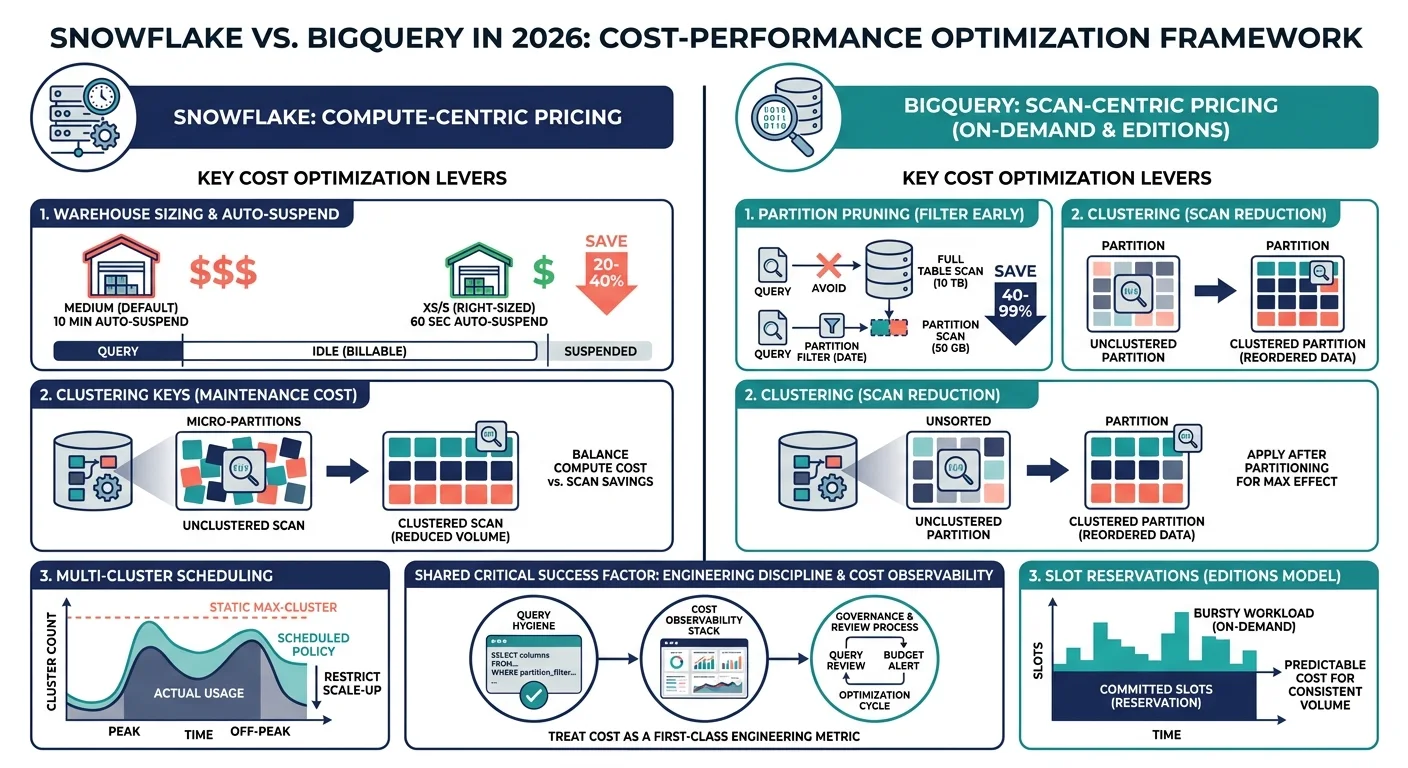
Snowflake vs. BigQuery in 2026: A CTO's Guide to Cost-Performance Optimization
Snowflake and BigQuery are both capable at scale, but capability is not the differentiator in 2026. Cost governance is. This post breaks down the compute and storage economics of both platforms and gives CTOs the specific clustering, partitioning, and SQL optimization techniques that actually move the needle on warehouse spend.